NCC secures 350 hectares of forest, wetlands, shoreline in Frontenac Arch

Posted Nov 16, 2025 01:05:09 PM.
Last Updated Nov 17, 2025 11:33:00 AM.
It has been a rough couple of years for the Blanding’s turtle. Already listed as a threatened species, the unique reptile has been on the short end of the stick with a series of development bills and proposals by the Ontario government.
Bill 23 and changes to the Conservation Act have put wetlands — the habitat of the yellow-breasted turtle — in harm’s way.
According to data from Ontario Nature, the Blanding’s turtle is less often spotted in southwestern Ontario, while records of the species are much more robust in the northeastern reaches.
A new initiative by Nature Conservancy Canada (NCC) will help to protect one of the remaining habitats of the Blanding’s turtle, while also preserving a sustainable ecosystem in the Frontenac Arch.
According to the NCC, the Frontenac Arch is within one of the most important forest corridors east of the Rocky Mountains. The area, where five forests converge, creates a unique and vibrant habitat for a wide range of biologically diverse species. The Arch connects Ontario’s Algonquin Highlands with the Adirondack Mountains in New York State. It offers a corridor for hundreds of migratory and wide-range species through a network of connected conservation lands.
“These ecosystems act as powerful carbon sinks, filter water, store carbon and produce oxygen,” the NCC said in a press release, noting that the conservation efforts help to strengthen the resiliency of the landscape and the well-being of surrounding communities.
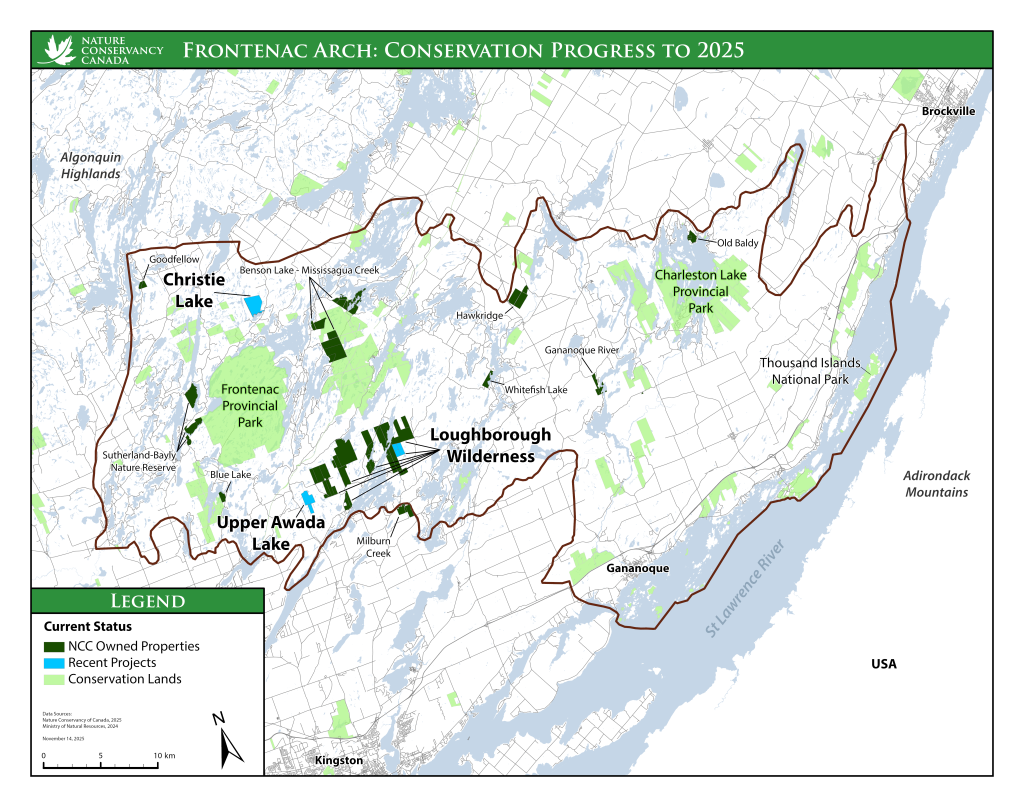
The NCC says it has been participating in over 20 years of conservation in the Arch. Over this time, over 3,200 hectares of natural habitat have been protected.
Three newly protected properties provide habitat for species at risk, including the Blanding’s turtle, gray ratsnake and eastern whip-poor-will, the NCC said.
The Christie Lake project will protect 1.2 km of undeveloped shoreline in the region. The Upper Awenda Lake Project bridges two major existing conservation areas. Finally, the Loughborough Wilderness project protects high-quality forest and wetland ecosystems while reinforcing a north-south forest core link.
“Conserving over 300 hectares of forests, wetlands, and freshwater shoreline in Ontario is a significant achievement to protect Canada’s biodiversity,” The Honourable Nathalie Provost, Secretary of State (Nature), said in a press release. “Protecting this landscape contributes to climate resiliency, while reinforcing the integrity of the region’s natural systems that provide essential ecosystem services, such as clean air and water.”

The three aforementioned projects are receiving support at both the federal and provincial levels.
Funding for these projects is contributed through the Government of Canada’s Natural Heritage Conservation Program and the Nature Smart Climate Solutions Fund, as well as the Government of Ontario’s Greenlands Conservation Partnership Program.
“Conservation at this scale doesn’t happen alone,” Rob McRae, program director for eastern Ontario at the NCC, said in press release. “It’s the result of strategic planning, strong partnerships and a shared commitment to protecting nature for future generations.”
“Our government is acutely aware of the challenges inherent in maintaining the critical balance of our shared planet, John Jordan, MPP for Lanark – Frontenac – Kingston, added. “I want to commend the NCC for your important work as stewards of this unique geographical reserve. Thank you for showing us the way forward to providing a cherished natural preserve, while respecting the biodiversity and migratory patterns of the Frontenac Arch.”