What does a ‘strong’ El Niño mean for Ottawa’s Rideau Canal?

Posted Sep 17, 2026 12:55:06 PM.
Ottawa’s favourite winter pastime is expected to face challenges this year as a “strong” weather phenomenon reappears.
Meteorologists from across the world are shocked at the “off the charts” ratings the El Niño climate pattern is showing, set to make notable impacts across the country in the coming months.
CityNews chief meteorologist Natasha Ramsahai confirmed the El Niño pattern could be the strongest on record based on the latest National Oceanic and Atmospheric Administration (NOAA) forecast.
El Niño is a cycle that usually alternates every two to seven years with La Niña (cooler-than-normal temperatures) and neutral conditions.
In the spring, forecasters indicated El Niño was present, but with its strong risk it’s possible it could bring unseasonably warm winters to several Canadian cities, including Ottawa. The World Meteorological Organization indicates a 100 per cent likelihood it will stick through February 2027 — the first time ever experts have been so unequivocal, it notes.
It hampers snow production and temperatures hover near 0 C, a problem the skateway has faced in the last two decades.
Global warming adding to El Niño’s impact
The last period the nation’s capital experienced a warmer winter, the Rideau Canal did not open at all, the first time in its history.
However, just because the last period forced people off the ice, does not mean each El Niño year will be the same, Marko Markovic, Manager, Meteorological Service of Canada, explained.
Looking at the data on the National Capital Commission’s (NCC) website, and comparing it to El Niño years, Markovic said earlier numbers show no real difference in whether the canal had a successful year.
“They tend to be shorter but El Niño is not to be blamed for that it’s more it’s more the global warming,” he told CityNews in an interview.
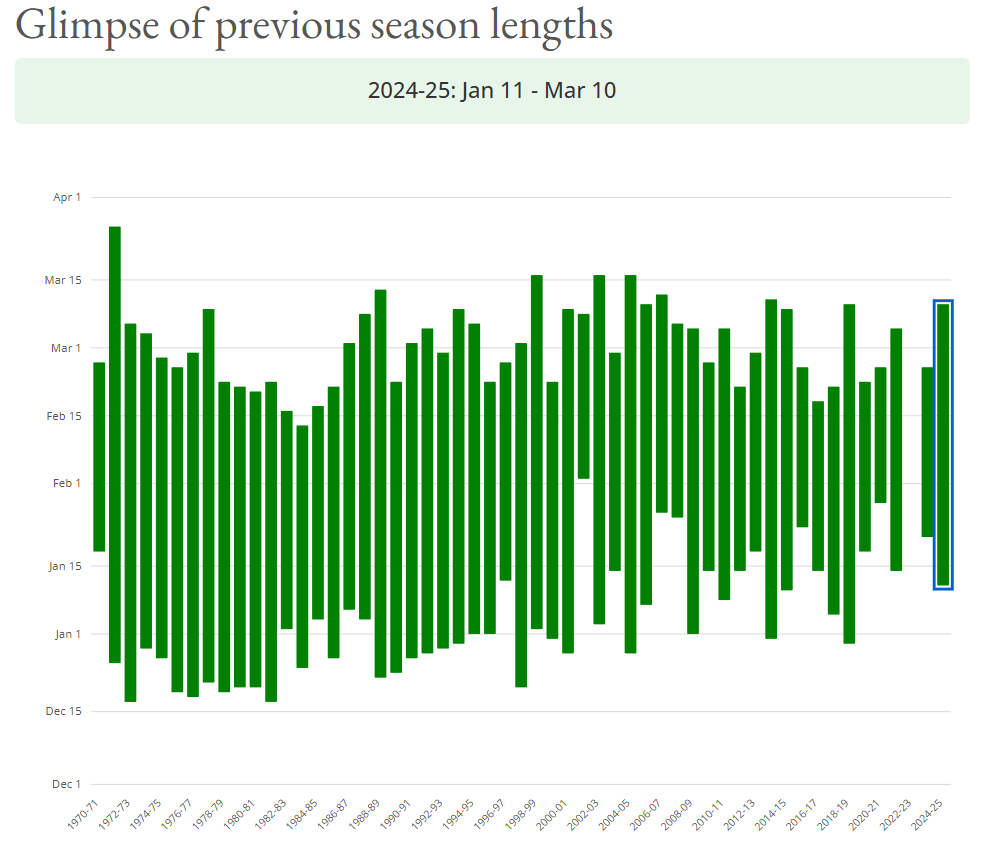
The graph by the NCC shows the length from when the skateway first opened there is a “visible” trend, Markovic said, that shows shorter seasons since the 2000s.
This can be explained because El Niño is not new. The phenomenon was first recorded in the 1890s, and since its discovery scientists have seen “stronger” years before, such as the 1982-83, and again 1986-88 seasons.
Which, according to the NCC’s data, the canal was open for a short period in ’82-83 (46 days) and reached March for the later seasons.
“So El Niño can add an additional warming influence on the top of the global warming trend,” Markovic said. “Over the last couple of decades starting from the year of 2007, it’s more correlated.”
How NCC, Carleton U are preparing
Forecasters like Markovic cannot predict how this year’s El Niño will impact the canal or what type of weather the city could see.
An NCC spokesperson said the organization is hopeful the conditions will allow for people to visit the canal this coming winter.
“At the same time, the realities of climate change have made skateway seasons increasingly difficult to predict,” Maryam El- Akhrass, of the NCC, said. “As we look ahead, we must also recognize that broader climatic factors, including the potential influence of El Niño conditions, may affect the upcoming season.”
Since 2022, the skateway has partnered with Carleton University to help mitigate and plan for weather disruptions and keep the canal open as long as possible.

Shawn Kenny, associate dean of the faculty of engineering at Carleton, told CityNews that milder temperatures and frequent rainfall are typical in Ottawa during El Niño periods.
“Depending on how these events are sequenced, they can either promote or hinder ice development. A delayed start is a possible outcome, but this is very difficult to predict with any certainty at this point in time,” he said. “A stretch of sustained cold in January and February may help maintain ice conditions in supporting a successful season.”
Through the partnership, the two organizations are uniting to get a Rideau Canal season this year, even with the challenges a warming climate mixed with a mild weather phenomenon present.