Canadians want cannabis policy to catch up: Abacus Data poll

Posted Nov 9, 2025 02:50:37 PM.
Last Updated Nov 15, 2025 02:59:00 PM.
Despite being the first major industrialized nation to legalize the adult use of cannabis — and second to Uruguay overall — Canadians are looking for policy shifts from the federal government that recognize the potential of the cannabis market.
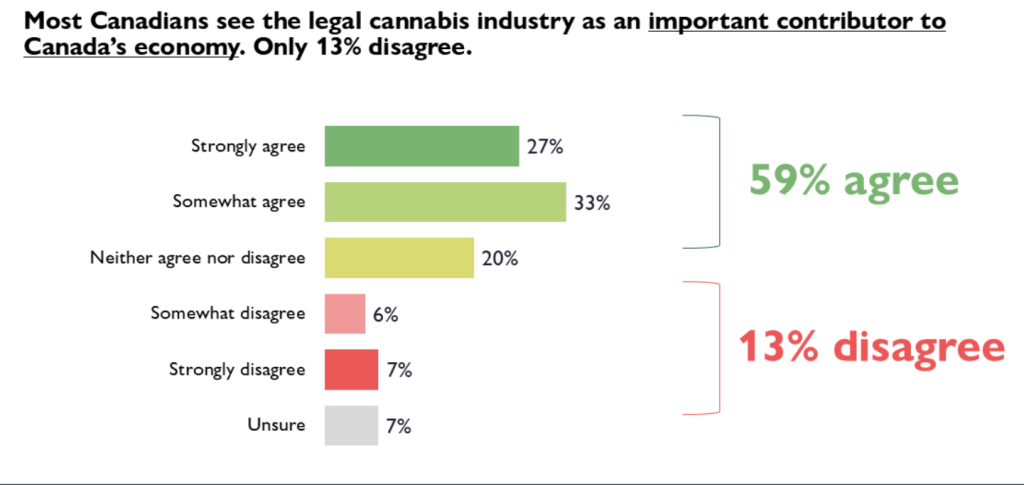
An Abacus Data poll produced on behalf of Organigram Global Inc. found that 59 per cent of Canadians believe the federal government should do more to promote jobs and innovation in the sector, citing the industry as an important part of the Canadian economy.
Beena Goldenberg, the CEO of Organigram Global, told CityNews the poll results show that socially, the stigma surrounding responsible cannabis use has abated, but policy has not moved forward.
“The original plan, in fairness to the government, they were creating an industry that hadn’t been legal before. They had made some initial assumptions when they put in the regulations. Their focus was on the health and safety mandate, objectives of legalizing cannabis and protecting youth. All valid concerns,” she said. “However, the industry has evolved and we really need the government to respond to some of the realities of the industry that they got wrong in their original regulations.”
Two policies that Goldenberg has been advocating for changes to are taxation and provincial stamp mandates.
Taxation for cannabis is about $1 per gram. Goldenberg said this number was reasonable when the cost of cannabis was $10 per gram, making taxes 10 per cent. But that price has now dipped to about $3 per gram, leaving companies with much higher excise taxes.
She says stamping has become a huge cost to the industry as different products come in different packages. Different stamps in each province also meant more work when products were ordered from elsewhere.
“What became very clear was that this complexity didn’t make this product safer,” Goldenberg said. “It didn’t prevent companies from paying their excise based on what province they sent it to. It was just a complexity that hadn’t been thought through at the time that it was put in place.”
The alcohol industry moved away from specific tax stamps for provinces in the 1980s. Now the entire industry has moved to a digital stamp that is more efficient.
Goldenberg said now is the optimal time for Canada to focus on the cannabis industry. With tariff troubles and the U.S. and Canada increasingly looking to further trade with European partners, she said it is time to capitalize on cannabis products.
Cannabis exports have been increasing amid a rapid expansion of medical markets across Europe. In the first six months of 2024, Canada exported a record number of cannabis flowers, increasing 98 per cent over the same period in 2023, according to data from Health Canada.
As these markets expand, it provides a unique opportunity for Canada. The United States cannot compete in cannabis exports because the product has yet to be legalized.
“The legalization debate is over (in Canada),” Goldenberg said. “We’re not talking about whether it should have been legalized or shouldn’t. We are now in the next phase, and this is about modernizing policy to unlock the sector’s economic potential.”
To increase the potential of the legal market, cannabis producers are saying more needs to be done to crack down on the illegal market.
Data from Health Canada states that in 2023, 72 per cent of cannabis users reported getting their product from a legal source (storefront or online), yet only 3 per cent reported getting their product from an illegal source.
But Goldenberg said the problem is that many consumers do not know which storefronts and websites are legitimate.
“They think that it’s legal and they’re clicking on it and they’re using their credit card, it’s being shipped to them and they have no idea it’s an illicit product,” she said.
A Statistics Canada survey found the illicit market still accounts for 30 per cent of cannabis sales.
“We’re competing against that illicit market who don’t pay excise taxes, that don’t adhere to the regulations, that don’t have all these extra costs,” Goldenberg said.
According to the Abacus Data poll, 43 per cent of Canadians want tougher enforcement against the illegal market to recover lost revenue and protect consumers.
Goldenberg said she was hoping some of these requests would come up in the federal government’s current budget deliberations, but so far, there have been no such advancements.
Charlaine Sleiman, a spokesperson for Health Canada, told CityNews in an email statement that the department made changes in March 2024 to streamline the Cannabis Regulations by simplifying labelling requirements, permitting the use of transparent packaging for certain products, and reducing record keeping and reporting requirements.
Currently, Health Canada is looking to streamline regulatory requirements under the Cannabis Tracking System Order which currently requires the legal industry to provide monthly reports about production and inventory levels.
“In addition, the department is reviewing the administrative requirements imposed on the legal industry in guidance and forms,” Sleiman said. “Both these initiatives are expected to deliver meaningful burden reduction for industry.”
While Goldenberg said the federal government is slow to act, she said the cannabis sector does have backing from many provincial politicians.
Organigram Global has its largest cultivation facility in Moncton, N.B. where it serves as the province’s fourth largest private sector employer. Goldenberg said Premier Susan Holt has provided much support for the industry.
New Brunswick is one province that is pushing to have cannabis beverages next to alcoholic beverages as an option in places where alcohol is sold.
In 2024 cannabis generated $16 billion in GDP which was greater than the alcohol industry.
When asked why the delay on the part of the government, Goldenberg said she believes stigma is still at play.
“It’s still looked at with a stigma. And the point of this data is that the public has moved on and the government is behind where the consumer sentiment is right now,” she said. “They don’t understand that consumers are fine, it’s a legitimate industry, it contributes to the economy.”