‘A love letter to the trees’ can be written on paper, just not virgin paper
Posted Mar 1, 2026 02:22:16 PM.
Last Updated Mar 2, 2026 11:46:00 AM.
Those who are making an effort to live more sustainably have probably heard the advice to use less paper in an effort to “save the trees.”
For those, it might come as a surprise that a sustainability advocate and non-profit worker would open a paper shop. But Carol Steuri’s shop on Beechwood Avenue is different.
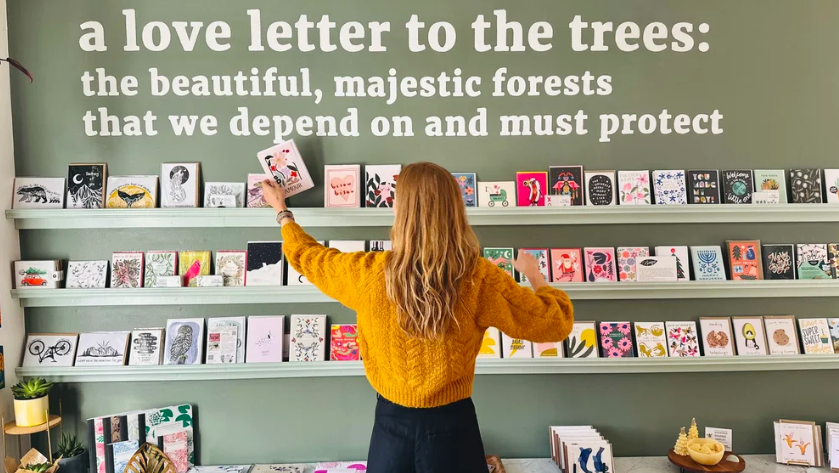
On the wall is written the words “A love letter to the trees.”
A Love Letter Paper Boutique just might be the only paper shop in the world that sells recycled and next-gen paper products. At least no others could be found when Steuri was researching her business idea.
“I’ve always wanted to have a European-style paper shop,” Steuri told CityNews. “I worked in Switzerland for many years, and every little Swiss town or British town or French town has a paper store, a stationery store.”
But it was actually the knowledge Steuri had in conservation that allowed her to carve out a niche where her paper products could exist sustainably.
“For the last seven years or so, I’ve been in a climate or some kind of social justice or environmental organization,” she said. “The last job I had was forest conservation, and I worked with big brands on their sourcing policies, both for paper and for textiles. So now I have all this knowledge of paper sourcing that I’m applying to now, finally following through on this little dream to open up a paper store.”
“We have so much recycled inputs to utilize. Just think about how many people order from Amazon on a weekly basis. It’s ridiculous that paper’s still coming from virgin sources,” she added.
Next-gen paper products are still fairly new in Canada, but Steuri said agricultural waste and textile waste are sourced from other places in the world to produce paper products.
But the source of that supposed waste might soon change.
The 2023 Buying Green Report found that globally, 82 per cent of consumers said they would pay more for sustainable packaging, rising to 90 per cent of Gen Z. If the demand continues to increase, supply will follow suit.
Despite a society that is increasingly turning digital, Steuri said there is still demand for products like hers.
“There’s also a bit of a resurgence on people kind of going back to older time mediums. And [for] a lot of young people, like journaling, for instance, is huge at the moment,” she said.
Various studies have shown that younger people still tend to prefer physical books to e-books. But that desire for something textile extends past just reading.
A 2022 survey by Keypoint Intelligence found that 62 per cent of office workers preferred to work with physical paper, and that rate was the highest among Gen Z.
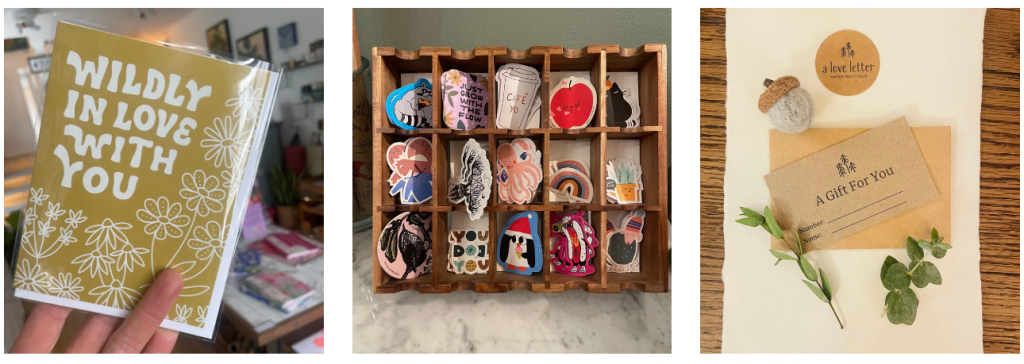
“It really spans (from) little kids looking for stickers to 90-year-old women and men who are stationary lovers and everything in between,” Steuri said about the customers that come into her shop. “I think people are seeking out tactile things and things you can hold and save. And we don’t do that on our digital devices.”
While a book and a social gathering might not seem to have much in common, they both represent a pushback against devices taking over our entire lives. Mixed with the sustainable shift, this is the kind of community Steuri is trying to build.
“I don’t want people just to buy things,” she said. “I want them to learn, and I want them to connect with others and buy these products and feel good about them. And then also encourage community building and connectivity.”
Steuri currently uses the upper level of her shop as a workshop space and rents out the backroom to a vintage clothing shop, and plans to continue working on community partnerships.
“It’ll always be a paper store on the main floor, but I can be creative with the other spaces,” she said, noting she can use some of the rooms in the old building to rent out to pop-ups or entrepreneurs who are looking to try out a new business idea.
But in the end, those businesses must share the same core values.
“There’s a big mantra on the wall of the shop,” Steuri said. “It says, ‘a love letter to the trees, the beautiful majestic forests that we depend on and must protect’.”